Let me tell you that a candle dream, in my understanding, can be also called a fixed-camera dream, a frozen dream (or, at least, near-frozen), an unwavering dream (even if the candleflame itself wavers), a static dream (even if it flickers slightly), a single-frame dream (even if the image imperceptibly strobes or, as they say in the trade, cartwheels), a single-flame dream (even if there is an after-image of a flame burnt on the retina by the original flame).
Simply put, a candle dream is of a single candle with a slightly flickering flame (with or without a candlestick, but usually with an ornate candlestick), and your minimalist view of it is as a slightly unwavering, non-shortening candle-wax and, from within the dream, perceived to be alight for eternity. A fear of eternity within a dream, let me tell those of you who are unaware of this fact, is the greatest fear of all. In other words, a candle dream is not a nice dream to dream. It cannot really be called a nightmare, I suppose, because nightmares are traditionally never static, never single-frame, indeed never single-flame. Nightmares have monsters and obvious fears and mutant echoes of life. Many who dream candle dreams rarely have contact with lit candles in real life. Many who dream candle dreams never complain of having nightmares.
One never knows whether any particular candle dream is the last candle dream you will ever dream ... whether, indeed, the eternity you sense from within the dream is a real eternity or not.
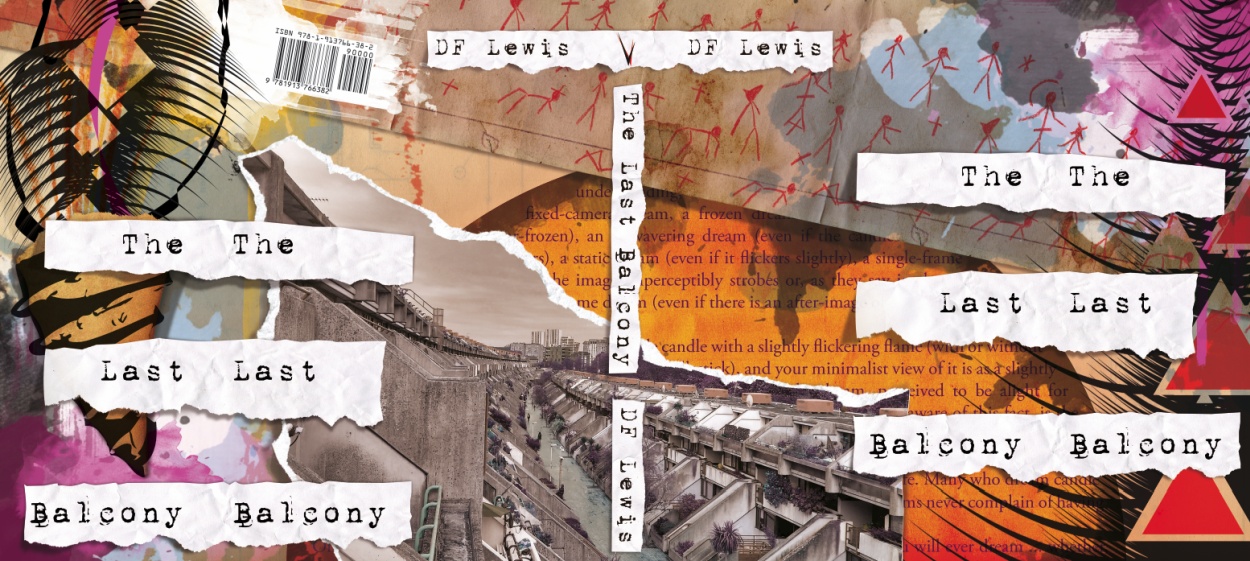
The Last Balcony by D. F. Lewis is a collection of quietly haunting stories at the intersection of reality and surrealism – where the ordinary and the familiar are seen through the lens of dream. Familiar spaces, familiar conversations, familiar encounters unfold into something far stranger and more uncanny where, like a surrealist painting, the world flows away through your fingers and escapes into a kind of fractured memory filled with both unease and poignancy – even nostalgia. The landscape of these stories is as British as a stroll through a classic seaside town and yet filled with enigma and uncertainty, leaving the reader to form their own connections with both the real and the psychological landscapes presented. The Last Balcony is a stunning collection of stories from a unique voice in British slipstream/horror/surreal fiction.
Contents:
A Pie with Thick Gravy
Warm Air
The Pillowghost Stories
My Giddy Aunt
A Work of Art
The Candlemass Stories
Chain Letters
Entries
Dorothy Alone
Candle-Dreaming
The House of Cutt
Headcount
Down to the Boots
Tugging the Heartstrings
The Plug
Sisters in Death
Starfish has Lost its Arm
Independent Image
The Mentioning
The Front Room
Crumbling Edges
The Resident
A Hairshirt Called Husband
Shaped Like a Snake
Gates
Mort au Monde
The Body in the Bed
Cloysters
Knee-Jerks for Nancy
Mr Rampives
Nancy’s Mother
The Horn of Europe
Was That a Message or a Movement?
A Benchmark for Ghosts
Glimpse
Nipping the Bud
Inside the Bud
Clad Bone
The Five Mentagras
Build a Character
Between White Lines
The Lost Balcony
When I was an Old Man
'Cloysters' - awesome. What a great story! Let me explain, if I can... It's very un-Des-like; it doesn't feel like a Des Lewis story on certain levels. So if I claim it's one of his best, will that somehow logically suggest that his normal work is too odd (a neat paradox that, I feel)? No, because although this story doesn't feel like Des in its packaging, it's Des through and through underneath; and although we might read it as a non-Des story, we'll think about it later as a bonfide total Des Lewis tale, one of his best, as I've already said.
- Rhys Hughes in 2012 about one of the stories: |


 Follow on Facebook